Chapter 1. Overview
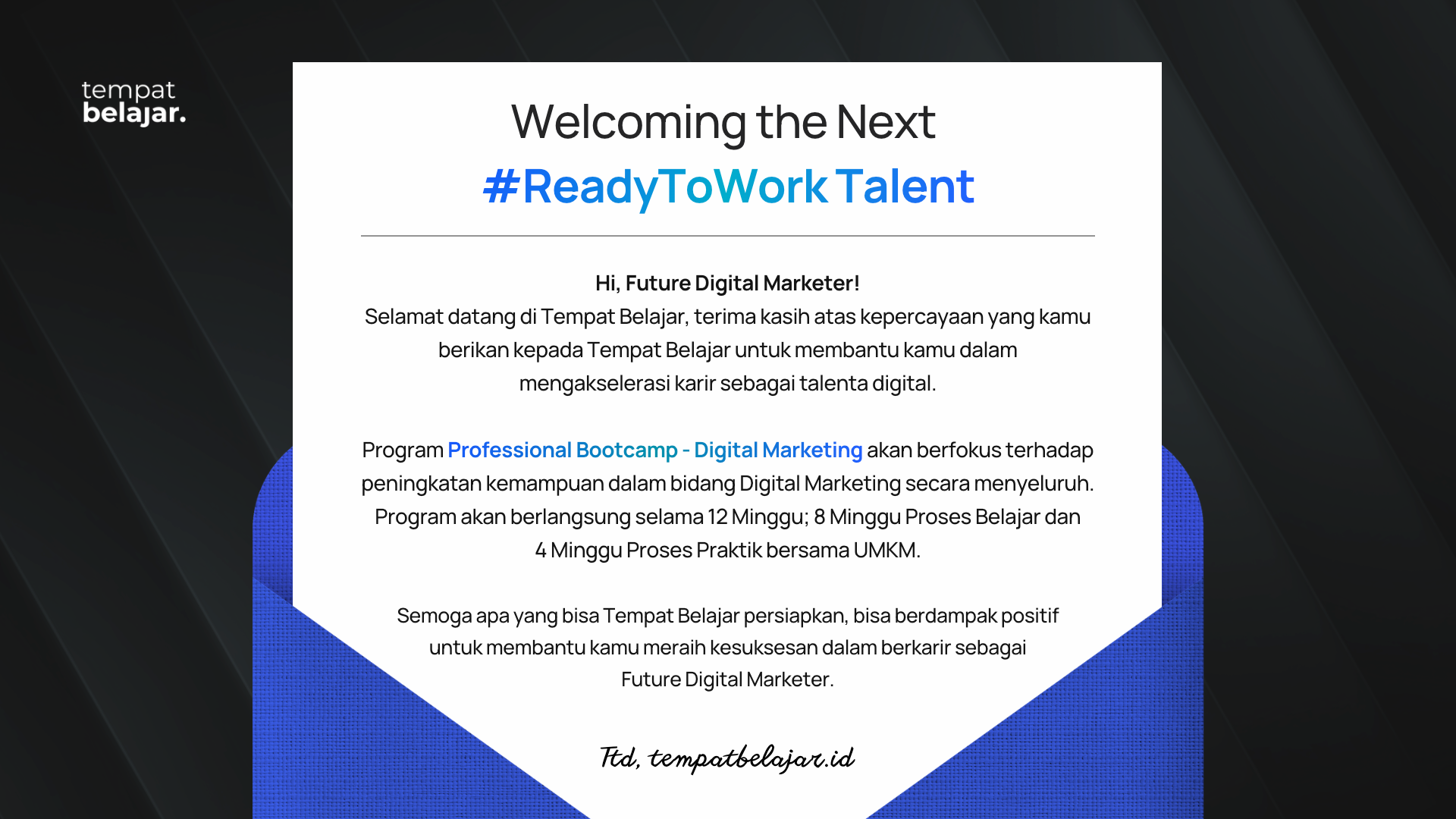
This onboarding session introduced the structure of the Professional Digital Marketing Bootcamp - Batch 27 at Tempat Belajar. It gave me a clear view of how the program connects foundational concepts, channel execution, analysis, and practical application within one learning journey.
Because this session focuses on orientation, this entry documents the roadmap and expectations I received at the beginning of the program. It does not represent completion of every module or the final project.
Chapter 2. Program Structure
2.1 A 12-Week Learning Journey
The program is presented as a 12-week journey. Its first phase concentrates on guided learning across digital marketing disciplines, while the final four weeks are planned around practical work with a real brand or SME. This progression is intended to move participants from understanding individual concepts toward connecting them in a realistic business context.
2.2 Learning Format and Support
The learning format combines live sessions, video material, post-tests, case-based exercises, assignments, demonstrations, and tutor support. The onboarding also explained how these activities are expected to reinforce one another: live and recorded material establishes context, exercises test understanding, and tutor access provides support between scheduled sessions.
Chapter 3. Curriculum Roadmap
3.1 Foundations, Research, and Organic Channels
The opening part of the roadmap covers digital marketing fundamentals, market research, customer personas, brand objectives, content pillars, copywriting, and social media planning. It then connects those foundations with landing-page development and search engine optimization, including search intent, keyword research, content briefs, publishing, tracking, and iteration.
3.2 Paid Media, Commerce, and Customer Relationships
The next group of topics introduces advertising fundamentals and budgeting across Meta Ads, Google Ads, and TikTok Ads, together with tracking and performance analysis. The roadmap also extends into marketplace marketing and CRM, showing how acquisition, conversion, and retention can be treated as connected parts of the customer journey.
3.3 AI, Strategy, and Analysis
Later topics are planned to explore AI-assisted research, content, advertising workflows, automation, prompting, and marketing analysis. These subjects are positioned alongside campaign strategy, competitor research, reporting, and data visualization so that AI supports clearer decisions rather than becoming a separate objective.
Chapter 4. Applied Project Phase
The final phase is planned as a four-week project with a real brand or SME. Participants are expected to work from a defined business context, receive weekly mentoring, document their decisions and results, and conclude the process with a report and presentation. For me, this is the point where the separate subjects in the curriculum are expected to become one structured marketing workflow.
Chapter 5. My Starting Point
I am entering the program with the goal of building marketing work from the problem outward: understanding the business objective and audience first, then selecting channels, preparing assets, and defining how performance will be measured. As the sessions progress, I plan to document what I actually learn and apply so future entries can focus on evidence from each session rather than repeating the initial curriculum plan.